Monday CRM Alternative for Individuals: Dex vs Monday
Dex vs Monday CRM: a 2026 comparison of features, pricing, and integrations to help you pick the right personal CRM.



Monday CRM Alternative for Individuals: Dex vs Monday
This post breaks down where monday CRM works, where it doesn't, and why Dex is the Monday CRM alternative most individuals end up choosing.
What monday CRM does well
Credit where it's due: monday CRM is a capable sales product.
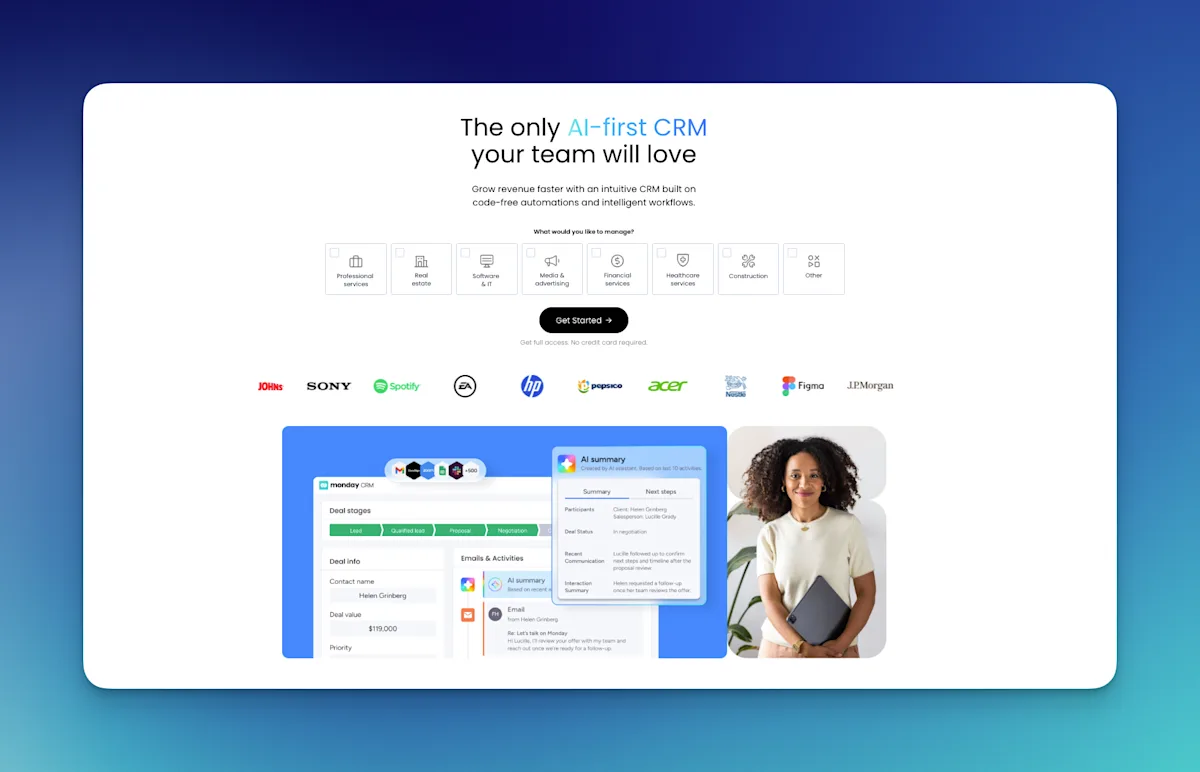
It sits inside Monday.com's broader "Work OS," which means you can run your project management, marketing operations, and sales CRM from one platform. For a team of five to 50 people managing leads through defined pipeline stages, it handles the job. Customizable boards, shared dashboards, automations that trigger when deals move between stages, sales forecasting on the Pro plan, and a growing set of AI tools including their Sidekick assistant and an app builder called monday vibe.
The 2026 updates are real. Monday.com added AI agents through an Agent Factory (still in early access), linked quotes and invoices directly to deals, and built an MCP integration that lets you query meeting transcripts in natural language. For revenue teams, these are useful additions.
But every one of those features assumes you have a sales motion. Leads coming in. Deals moving through stages. A team that needs shared visibility. If that describes your work, monday CRM earns its price. If it doesn't, you're paying for machinery you'll never turn on.
Where monday CRM falls short as a personal tool
The problems start with pricing. monday CRM charges per seat with a three-seat minimum on every paid plan. Even if you're one person, you're paying for three. The Basic plan is $12 per seat per month billed annually, which means your real entry cost is $36 per month, for a tool that caps you at 1,000 active contacts on that tier.
Then there's the data model. Everything in monday CRM orbits around deals, leads, and accounts. That works for tracking a prospect through qualification to close. It doesn't work for remembering that you met someone at a dinner party, they're launching a company, and you said you'd introduce them to your friend who does brand design. Personal relationships don't have pipeline stages.
The integration gaps are the other issue. monday CRM connects to Gmail, Outlook, and business tools. It doesn't sync with LinkedIn, WhatsApp, iMessage, Instagram, or Facebook. For most people I know, professional relationships don't live exclusively in email. They're spread across DMs, texts, and social platforms. A CRM that only sees your inbox is looking at maybe half the picture.
And there are no keep-in-touch reminders. No recurring nudge that says "you haven't reached out to Mark in two months." monday CRM tracks deals forward. It doesn't track relationships over time.
Dex vs monday CRM: feature comparison
Feature | Dex | monday CRM |
Built for | Individuals | Sales teams |
Pricing | $12/month flat (one user) | $12/seat/month (3-seat minimum) |
Real entry cost | $12/month | ~$36/month |
Contacts | Unlimited | 1,000 (Basic), 10,000 (Standard), unlimited (Pro) |
LinkedIn sync | Yes (up to 9,000) | No |
Gmail sync | Yes | Yes |
Outlook sync | Yes | Yes |
WhatsApp sync | Yes | No |
iMessage sync | Yes | No |
Instagram sync | Yes | No |
Keep-in-touch reminders | Yes (kanban board) | No |
Pre-meeting briefs | Yes (auto-emailed) | No |
Job change alerts | Yes | No |
AI features | Copilot, AI Assist, Messaging Dex | Sidekick, vibe app builder, AI agents |
Deal pipelines | No | Yes |
Team dashboards | No | Yes |
Sales forecasting | No | Yes (Pro) |
Quotes and invoices | No | Yes (Pro) |
Business card scanner | Yes | No |
Mobile app | Yes (iOS + Android) | Yes |
Browser extension | Yes (Chrome) | No |
Free trial | 7 days | 14 days (Pro) |
The pattern is clear. monday CRM has pipeline management, team dashboards, and sales automation. Dex has social integrations, relationship reminders, and AI built for one person managing their own network. Different tools for different problems.
Who needs Dex as a Monday CRM alternative
People looking for a Monday CRM alternative usually fall into a few categories. We've talked to hundreds of them over the years building Dex.
Solo founders and entrepreneurs. You're juggling investor conversations, advisor check-ins, potential hires, and partnership intros. You don't run a sales process. You run a network. A personal CRM for founders that pulls contacts from LinkedIn, email, and WhatsApp into one place and reminds you when someone's overdue for a follow-up is more useful than a deal board.
Investors and VCs. Deal flow is relationship-driven. You need to track hundreds of founders, co-investors, and portfolio contacts across events, emails, and messages. monday CRM's pipeline view can model deals, but it can't track the relationship layer underneath — the part where you remember someone mentioned they're pivoting, or that you promised an intro three months ago. A personal CRM for investors handles that.
Job seekers. You're meeting recruiters, referral contacts, alumni, and hiring managers across LinkedIn, email, and coffee chats. Pipeline stages don't map to "had a great informational, should follow up in two weeks." You need a system for organizing your job search around people, not deals.
MBA students. Business school throws hundreds of new contacts at you in a short window. Keeping those relationships warm after graduation is the hard part. A personal CRM for MBA students with reminders and context beats a sales tool every time.
Consultants, freelancers, and solopreneurs. Client relationships drive your business, but you don't have a five-stage sales funnel. You have people you need to stay in touch with. A personal CRM built for solopreneurs fits better than enterprise sales software.
Pricing: what you pay for
Pricing is where the Monday CRM alternative conversation gets concrete.
Dex costs $12 per month billed annually. One user, one price. That includes unlimited contacts, notes, and reminders, plus Gmail and calendar integrations, LinkedIn sync, WhatsApp and iMessage sync, custom fields, and AI features. The Professional plan at $20 per month adds mail merge, Outlook support, expanded LinkedIn sync (9,000 connections), API access, and Zapier. Both plans come with a 7-day free trial.
monday CRM is priced per seat, billed annually, with a three-seat minimum on every paid plan:
Basic ($12/seat/month): Unlimited pipelines, 1,000 active contacts, one dashboard.
Standard ($17/seat/month): Two-way email sync, AI email generator, activity management, 250 automation actions per month, 10,000 active contacts.
Pro ($28/seat/month): Sales forecasting, email sequences, mass emails, quotes and invoices, Google Calendar sync, 25,000 automation actions, unlimited contacts.
Enterprise (custom pricing): Lead scoring, team goals, advanced analytics, HIPAA compliance.
Monthly billing runs higher — roughly $18, $25, and $41 per seat for Basic, Standard, and Pro.
The math is straightforward. An individual on Dex pays $12 per month for unlimited contacts and every integration. An individual on monday CRM pays at minimum $36 per month (three seats, Basic) for 1,000 contacts and no social integrations. To get email sync and more than 1,000 contacts, you're at $51 per month (Standard). You're not comparing prices — you're comparing categories.
How the two tools work day to day
Getting set up
Dex: Sign up, connect your accounts (LinkedIn, Gmail, calendar, social), and your contacts start flowing in. Most people are running within 10 minutes. The integrations hub puts all your connections on a single page.
monday CRM: You build boards, define pipeline stages, connect integrations, configure automations, and set up team permissions. It takes longer because there's more to configure — and more to maintain as your process changes.
After meeting someone new
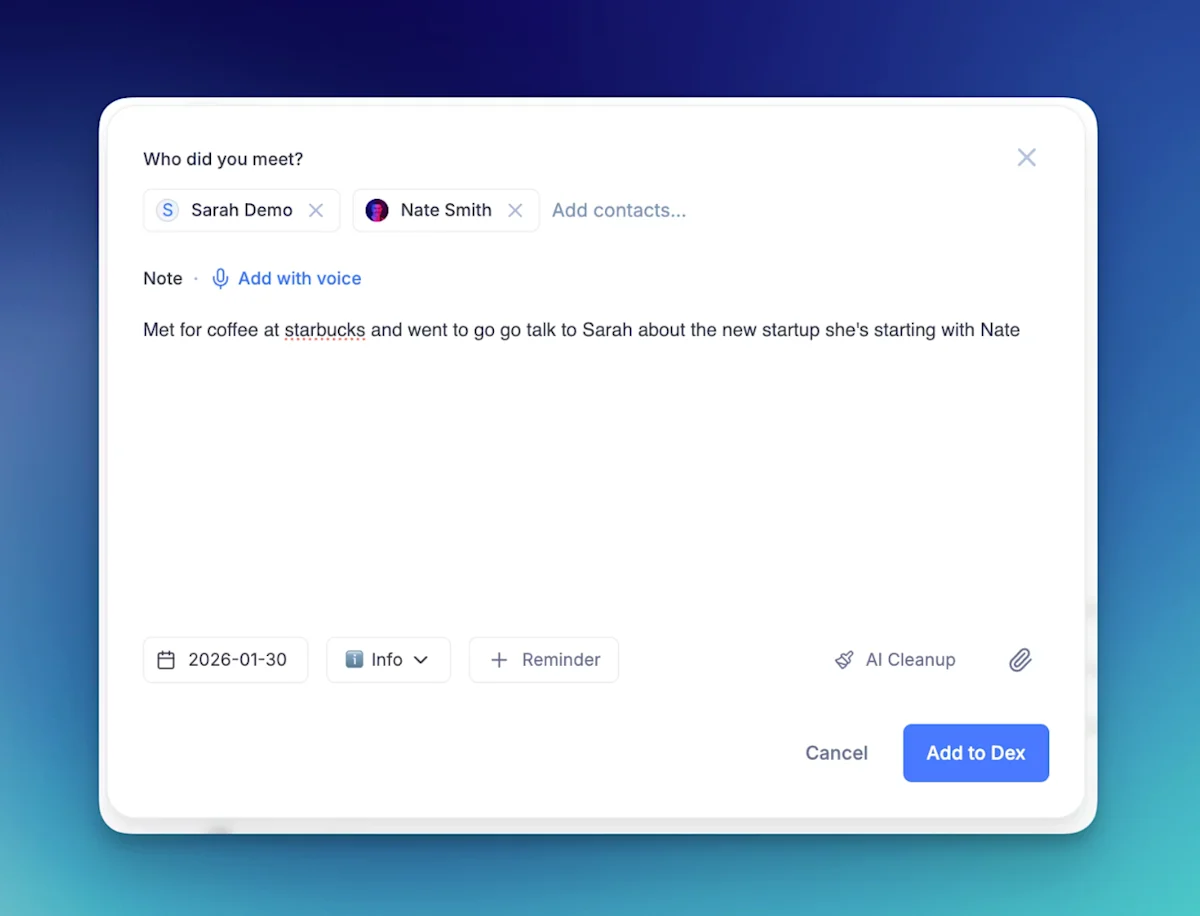
Dex: Add the contact (or let the integration pull them in). Write a quick note. Set a follow-up reminder. When the reminder surfaces, you have the full context — past notes, emails, meetings — in one timeline.
monday CRM: Add the person as a lead on a board. Fill in deal and account fields. Assign a pipeline stage. Log the activity. Set up or trigger automations. It's thorough, but it's a lot of steps for "I met someone interesting and want to stay in touch."
Staying in touch over months and years
This is where the gap is widest. Dex is built around the problem of maintaining relationships over time. Keep-in-touch reminders surface people on your chosen cadence. Pre-meeting briefs email you a summary before calls so you walk in prepared. AI Assist suggests conversation starters based on your notes and their recent activity.
monday CRM is built around moving deals forward. It tracks pipeline progress and logs sales activities. Periodic "how's it going?" check-ins with non-sales contacts aren't really what it's designed for.
What's new in Dex (2026)
A few recent updates (as of July 2026) worth knowing about if you're evaluating Dex as a Monday CRM alternative right now:
Connect Dex to Claude and ChatGPT.
Dex now supports MCP (Model Context Protocol), so AI assistants like Claude and ChatGPT can plug straight into your contacts and relationship data. Search contacts, log notes, set reminders, and organize your network through natural conversation — with the Dex Skill adding meeting prep, follow-up suggestions, and duplicate cleanup on top.
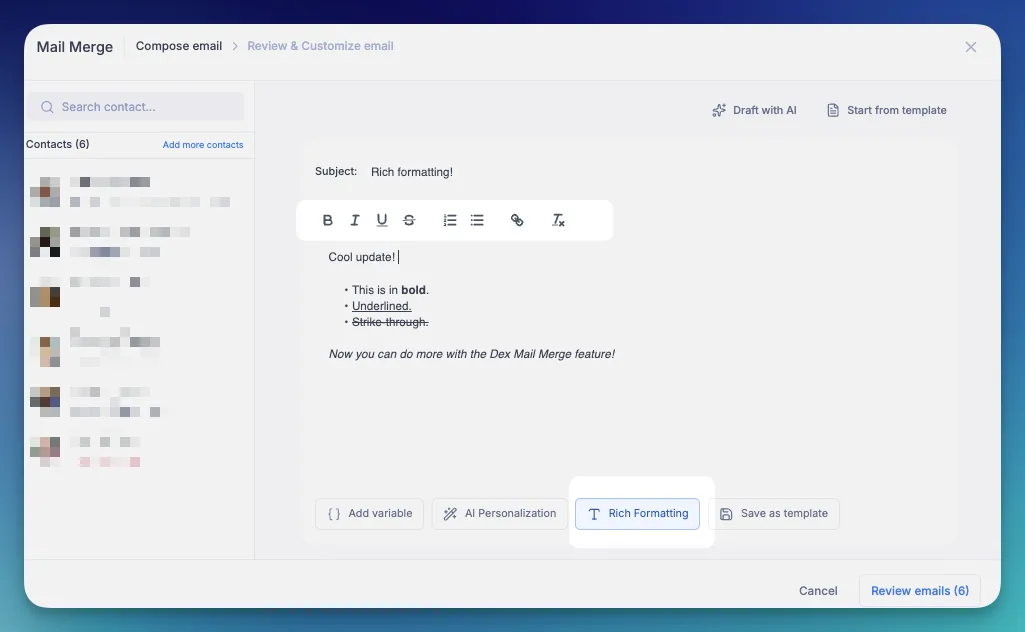
Mail Merge. Send personalized bulk emails to up to 200 contacts in one workflow, each with dynamic
(Rich text format) you can customize,and optional AI-drafted copy. Works withGmail and Outlook (web only, Dex Professional).
Custom fields on the contacts view. Surface fields like hometown, company, spouse, or important dates right from the main contacts view. Click Properties on any contact or group and pick the fields that matter most.
Quick add from one place.
Add new contacts, notes, reminders, and interactions from a single streamlined interface — no more hopping between screens.
Check our latest updates at our changelog page.
What's new in monday CRM (2026)
monday Sidekick.
A context-aware AI assistant that creates dashboards from plain-language requests and surfaces risks and priorities.
monday vibe.
An AI app builder — describe what you need and it generates the view or widget.
AI agents and Agent Factory (early access).
Specialized AI agents for tasks across your workspace, plus a builder for creating your own.
Quotes and invoices linked to deals.
Recipient and product details auto-fill from deal items.
Meeting transcript queries via MCP.
Ask questions across transcripts in natural language.
Sales automation upgrades.
AI email generator, email sequences, sales forecasting, and integrations like the Meta Conversions API continue expanding across Standard and Pro.
Why Dex is the Monday CRM alternative most individuals choose
If you need a sales CRM, monday CRM is a solid product. Pipeline management, team dashboards, automations, forecasting — it does those things well, and the 2026 AI additions make it more capable. For a team closing deals, the per-seat pricing buys real infrastructure.
But if you're one person trying to manage relationships, monday CRM gives you too much of what you don't need and not enough of what you do. No LinkedIn sync. No WhatsApp or iMessage. No keep-in-touch reminders. No pre-meeting briefs. A three-seat minimum that triples your cost. Pipeline stages where you need a simple timeline of "when did I last talk to this person, and what did we discuss?"
Dex does the job you actually have. It pulls contacts from LinkedIn, email, calendar, WhatsApp, iMessage, Instagram, and Facebook into one place. It reminds you when you're falling out of touch. It gives you context before meetings without you asking. And it costs $12 per month for one person with unlimited contacts. No seat minimums, no board configuration, no setup project.
If you've been using monday CRM and it feels like more tool than you need, try Dex free for 7 days and see the difference.
Frequently asked questions
Is monday CRM good for personal use?
Not really. monday CRM is a sales tool built for teams managing leads, deals, and pipelines. You could use it as a contact tracker, but you'd be paying for at least three seats (minimum $36/month), configuring boards and pipeline stages you don't need, and missing integrations like LinkedIn, WhatsApp, and iMessage that matter for personal relationships. For individual relationship management, a dedicated personal CRM like Dex is a more natural fit.
What is a good Monday CRM alternative for individuals?
Dex is the most common Monday CRM alternative for people who want a personal CRM rather than a sales platform. It gives you unlimited contacts, keep-in-touch reminders, LinkedIn and social integrations, AI-powered follow-up suggestions, and a flat $12/month price with no seat minimums. Other personal CRMs exist, but Dex has the broadest integration set and the strongest focus on relationship maintenance over time.
What is a personal CRM?
A personal CRM helps you manage personal and professional relationships as an individual, not a sales team. It organizes your network with notes, reminders, and interaction history, and modern personal CRMs add AI that suggests follow-ups and surfaces context from past conversations. Think of it as a private system that combines your address book, calendar, and notes with the memory you wish you had.
Here's a deeper look at must-have personal CRM features.
How much cheaper is Dex than monday CRM?
For a single user, Dex is $12/month (billed annually) with unlimited contacts. monday CRM requires at least three seats, so the minimum is $36/month on Basic (with only 1,000 active contacts) or $51/month on Standard (for email sync and 10,000 contacts). Dex is 66-75% cheaper depending on which monday CRM plan you'd need.
Can Dex replace monday CRM for managing contacts?
If you're managing personal and professional relationships, yes. Dex handles contact organization, interaction history, reminders, notes, custom fields, and groups. It also syncs with more platforms than monday CRM — LinkedIn, WhatsApp, iMessage, Instagram, and Facebook on top of Gmail, Outlook, and calendars. What Dex doesn't replace is monday CRM's deal pipelines, team dashboards, sales forecasting, and automation workflows. If those are what you use monday CRM for, you need a sales CRM, not a personal one.
Can I use monday CRM for free?
monday CRM offers a 14-day free trial of the Pro plan. There's no permanent free plan for the CRM product. After the trial, the cheapest option is Basic at $36/month (three seats at $12 each, billed annually). Dex offers a [7-day free trial](https://getdex.com) at $12/month after that for a single user.